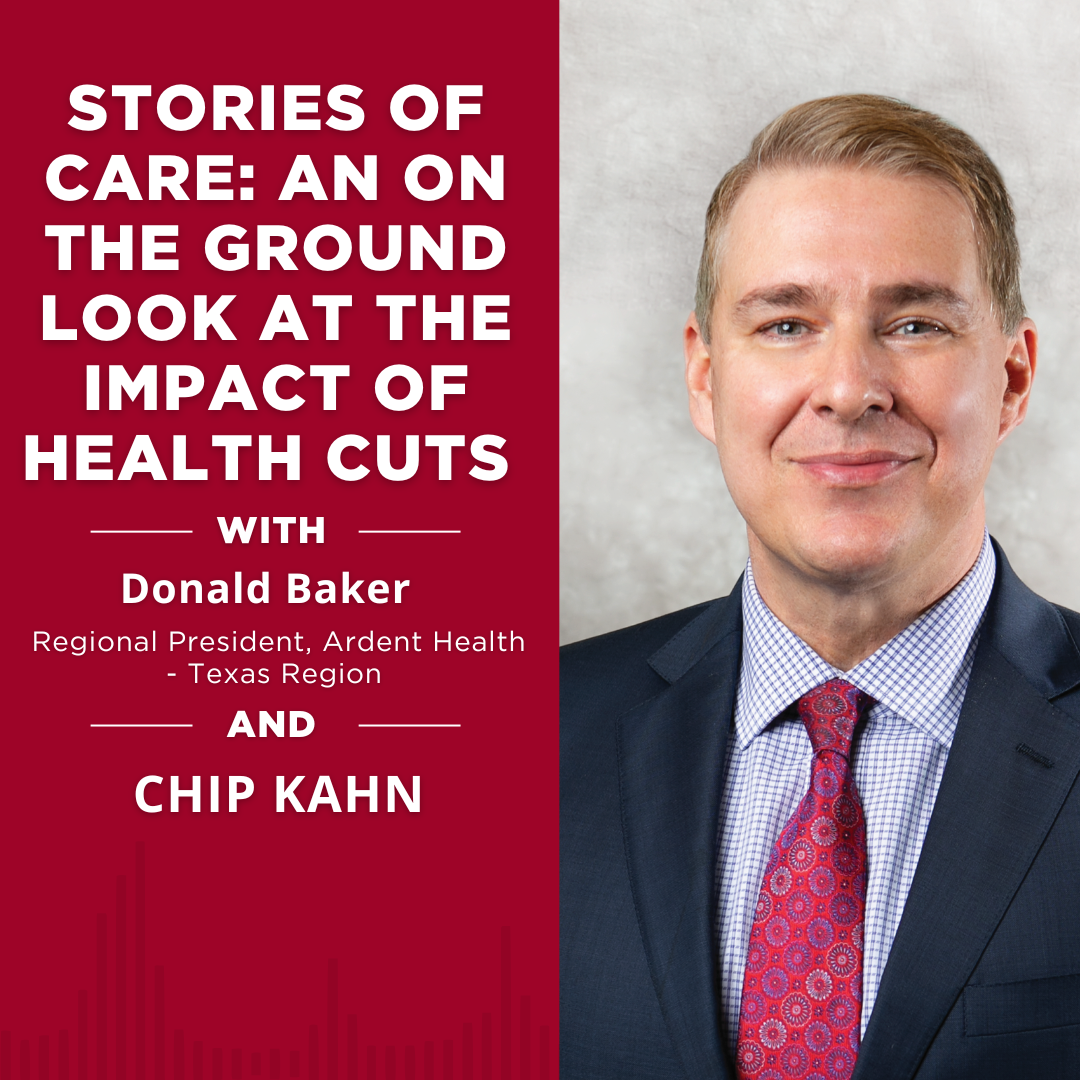
Stories of Care: An On-The-Ground Look at the Impact of Health Cuts
Recently passed Medicaid cuts are estimated to increase the number of uninsured by over 10 million. That number climbs to over 16 million when you factor in the upcoming expiration of the enhanced premium tax credits that enable hardworking Americans to afford to purchase their own health insurance from the exchanges.
Hospitals serve every patient who walks through their doors, regardless of their insurance or lack-thereof. These cuts will impact their ability to keep the lights on and reduce patients’ access to care – all of which has damaging effects on the surrounding community.
On today’s episode, Donald Baker, Regional President for Ardent Health’s Texas Region, takes us inside the UT Health East Texas hospital system. Donald explains just how damaging recently passed health care cuts, and the possible elimination of the enhanced premium tax credits, could be not just on patient care, but on the health and economic wellbeing of the entire East Texas community.
Donald Baker [00:00:02]:
We all keep showing up every day. We’re called to purpose, we’re called to mission, and no matter what, we’re going to be tireless to keep our doors open and to be there for our communities. But it would be, I think, just intellectually dishonest to say that it would not have those kinds of cuts or cuts like that over time would not have significant effect on the sustainment of service line availability.
Narrator [00:00:29]:
Welcome to Hospitals in Focus from the Federation of American Hospitals. Here’s your host, Chip Kahn.
Chip Kahn [00:00:38]:
Thank you for joining me today for a special episode of Hospitals in Focus. This season on the podcast we have focused on unprecedented cuts facing 24. 7 patient care recently passed. Medicaid cuts are estimated to increase the number of uninsured by over 10 million. That number climbs to over 16 million when you factor in the upcoming expiration of the enhanced premium tax credits that enable hardworking Americans to afford to purchase their own health insurance from the exchanges. Hospitals serve every patient who walks through their doors, regardless of their insurance or lack thereof. These cuts will impact their ability to keep the lights on. Today we’ll hear firsthand from a hospital executive navigating challenges facing healthcare due to Congress’s healthcare cuts.
Chip Kahn [00:01:30]:
Donald Baker is the Regional President for Arden Health’s Texas region. Previously he served as Chief Operating Officer and Chief Financial Officer for UT Health East Texas, a comprehensive network of hospitals. He will expertly explain what healthcare cuts mean for everyone’s access to care in their community.
Donald Baker [00:01:55]:
My name is Donald Baker, I’m the Regional President for Ardent in Texas and I cover market president for UT Health East Texas, which is a comprehensive joint venture in the east side of the state with the University of Texas serving quite a large region with full service of comprehensive care. UT HealthEast Texas we’re an integrated care delivery network and what’s unique for us? A few things. First, just geography. We cover 12,000 square miles and I think there’s certainly other health networks out there doing the same. But that’s what happens in rural and Texas and areas like that. So significant geographic coverage area. We span more than a dozen counties, over 90 access points, with focusing on comprehensive, accessible care to over a million people across that region. Our delivery network includes nine hospitals, a large acute care hospital which is a teaching facility, the region’s only Level 1 trauma location in all of the east side of the state, as well as critical access and mid sized rural hospitals.
Donald Baker [00:02:59]:
We do have a wide variety of primary care and urgent care clinics, including specialty physician clinics placed throughout the region both in rural and in Suburban areas. I do think one unique aspect of our network is we combine care delivery across that wide geography base with physician and clinical provider training in partnership with the University of Texas at Tyler. We do that for both medical residents as well as medical students from UT School of Medicine there. At UT Tyler, that includes rural rotations, rural representation, as well as in larger communities. And as a teaching system, we really think it’s critical to help build on the next generation of physicians, next generation of providers, clinicians not only across East Texas, but for rural communities and larger, more comprehensive settings in East Texas as well. We train many doctors that will work across not only the east side of the state, but also in Dallas and Houston. So that’s a really important part of our mission. Our patients live in a mix of smaller to mid sized communities, towns throughout East Texas.
Donald Baker [00:04:03]:
These would be rural agricultural farming communities, industrialized production occupations that are inside of there, and a few more urbanized centers like Tyler actually, which has more of a diverse job base. But our patient base faces a much higher rate of chronic conditions and socioeconomic as well as geographic barriers to to care than what would be present in a lot of more urban settings. These services most often sought the patients that we see, they’re seeking primary and preventative care. They seek emergency services, including trauma, which is being the only trauma provider in all of East Texas. That’s a significant part of the safety net we provide. But they also seek advanced cardiology, pulmonology, orthopedics, advanced surgical capabilities, as well as oncology and maternal care. And we’re providing all of that across the east side of the state in a very coordinated, comprehensive way. And we feel like we’re doing that in a way that takes advantage of a regionalized system done effectively to try to focus on lowering costs of care and providing access that not only improves outcomes, but it creates a healthier community and I think a much more stable base for the folks across East Texas to not only seek employment, but to just live and live thriving lives.
Donald Baker [00:05:21]:
From a payer perspective, coverage is often government supported. For us. A significant portion of our patients are covered by Medicare and Medicaid and that also many of them rely on enhanced premium tax credits. These are the type that afford marketplace insurance. And then we have others that remain uninsured and a larger percentage than many other organizations that are in an urban setting. You know, this creates a unique financial and care coordination challenge. It underscores the need for our mission candidly and. But we certainly focus on taking care of all that need us and come to us both on our emergency rooms and those that we take care of in our clinics, in our hospitals for elective care.
Donald Baker [00:06:04]:
I think rural hospital care faces two big hurdles. People and resources, candidly, and people crosses many domains and then resources do as well. But on the workforce side, recruiting and retaining skilled clinicians in rural areas is a challenge. It’s a real challenge. We’ve really focused in our system of meeting that head on. We’ve developed local training programs that grow talent close to home. Our teaching partnership with the University of Texas at Tyler and the University of Texas School of Medicine not only trains physicians, but it also trains nurses. It trains allied health professionals, advanced practitioners, including PAs, all that would go into that.
Donald Baker [00:06:45]:
And that partnership, I think, is a best of breed. Candidly, I think it’s focused on not only providing care today, but positioning systems to provide broader access of care over the future. Not just our system, but other system. Many of the folks we train will work for other organizations. We say that’s part of our mission. But our hospitals, I think one thing that I’ve learned in my career is our hospitals in these areas, they’re really essential infrastructure components to these communities. In most communities we serve, we’re the only source for emergency care, the only source for maternity care, the only source for specialty care. And for maternity care that includes prenatal care.
Donald Baker [00:07:30]:
We see it in areas where significant percentages, if not the majority of deliveries, have no prenatal care. And creating the opportunity for that to be present has not only significant benefit to that mother and that baby and outcomes, but it affects families, it affects communities, it affects many other people. And we see that need. We take it very seriously. We’ve been focusing on how to partner with others and how to develop the ability and train folks to extend that out for the benefit of East Texas. We say it’s part of core, part of our purpose. You know, from a patient side, you think about the patient side, Rural populations, they have higher rates of chronic illness, more transportation barriers, less access to primary care, specialty care, preventative care. When services are needed, they tend to be much more emergent, they tend to be much more extreme.
Donald Baker [00:08:24]:
The illnesses are progressed much further where it could have been affected significantly if seen earlier. Those are, I think, some of the challenges we see. And it leads to higher costs and a lot of impact to the health delivery side. But more importantly, it leads to worse outcomes and a lower health overall status for the folks that don’t have that access. We’ve seen that time and time again. That’s been a Big focus of ours, with the formation of our system and our partnership with the University of Texas in that regard, which part of our mission is not only to care for our patients and our communities, but it very much focuses on, over time, training clinicians of the future because we know that’s going to lead to improved outcomes in these areas, which we take very seriously, and it’s a core part of our calling. But then the reality is financial realities, they can’t be ignored. Medicaid reimbursement, government reimbursement largely doesn’t cover full cost of care, particularly when you’re dealing with emergency care of a significant nature.
Donald Baker [00:09:26]:
And financially, rural hospitals operate on incredibly thin margins to no margins, and that’s not unique to us, that exists across the state. And so sustaining access means ensuring programs like state directed payments remain strong. I think those are elements that come up in policymaking that are very key to what happens in rural community and the future of rural healthcare. Certainly in Texas. I’ll opine on Texas for this. But those areas and elements of funding, they’re not additive. They’re the ability to sustain care in areas where otherwise these facilities would be very difficult to be sustained in order to provide the services they provide, including the economic effect they provide for those areas. I think these cuts would have a significant ripple effect not only throughout our system, but throughout these communities.
Donald Baker [00:10:16]:
Reduced funding could affect everything from staffing, service lines, sustainability, availability. Candidly, particularly in the rural hospitals operating on thin margins, which are most not only for us, but for many others, it would lead to. Sometimes, I think a factor that’s not seen is obviously the access to care would be affected and outcomes for people’s lives and their families would be affected. But it also would lead to loss of jobs and investment in areas where those facilities often represent the most significant source of employment and economic stimulus for the economy of the broader community that they serve. We know that hospitals represent the heartbeat of many communities. They’re the central infrastructure there that provides so much to these communities. And I think that’s an unintended collateral effect to cuts like these or potential cuts that could occur. Candidly, it would represent more uninsured patients, which creates more strain, and that would be strain on all health systems throughout the region, both in the rural settings as well as those in larger communities and in ultimately urban communities.
Donald Baker [00:11:31]:
If over a million Texans lose Medicaid coverage, we would see significantly higher ER volumes, much longer wait times for access to care for everyone, not just those that would be affected by that, and ultimately significantly increased Uncompensated care costs. And that will affect everything that’s in that arena. Everything from job employment, capital investment, job sustainment, and ultimately investment in communities. More importantly, it will affect health outcomes and health statuses for the folks that live in these communities. But it is, it is an impact to all of that. We see it in its entirety. You know, we’ll keep showing up every day. We’re called to purpose, we’re called to mission.
Donald Baker [00:12:15]:
And no matter what, we’re going to be tireless to keep our doors open and, and to be there for our communities. But it would be, I think, just intellectually dishonest to say that it would not have those kinds of cuts or cuts like that over time would not have significant effect on the sustainment of service line availability. When we talk to policymakers and others, one of the message we’ve tried to offer is for policymakers to understand there’s a real world impact that’s not just on access and outcomes, but it’s on overall economic health. It’s on overall vibrancy of these areas that represent a significant population of people. When you put them all together, including as I mentioned, job creation and sustainment. The hospital serve more than just a clinical access point for these communities. They are major lifelines and sources of care in these places and impact in these places in a much broader way than just the care they deliver, which is the most important. Programs like Medicaid and premium credits, they’re, they’re not luxuries.
Donald Baker [00:13:20]:
We see them as foundational. They’ve been inherent into a multi year significant decade plus long economic system that’s had a lot of investment in it from a lot of different domains of the economy. And I believe they’ve become foundational. More than 2 million Texans use these credits to afford coverage. That is a significant number. And if these lapse families would lose access or face premiums they simply can’t pay. Losing coverage means delayed, costlier care. Without insurance, people that delay care will delay care till it’s urgent.
Donald Baker [00:13:59]:
That is what we’ve seen time and time again. That leads to a regression in the overall health of a community or the health of the population. But it leads to a series of worse outcomes and higher costs for everyone, actually, not just us. It’s a reduced productivity for employers, it’s reduced impact on employers in the region that are outside of hospitals and clinics. And it leads to additional strain on hospitals and clinics that in many cases already operate with very thin margins. And I think you would see that across the state of Texas. It’s not unique to UT Health East Texas. We see this as, and I see this as about continuity.
Donald Baker [00:14:39]:
Extending the credits protects coverage that’s been in place. The economic models to a large extent have been built around and progressed over the last few years with investment in these communities. With this in place, the coverage that are there, it keeps people connected to primary care rather than the ER becoming primary care. That’s going to help employers, that’s going to help everyone be more productive and ultimately, I think leads to economic benefits in the region where they are and where those exist that are hard to measure, not just the impact of the hospitals. If the coverage goes down. There’s a broader implication, I think, to the workforce and that affects the economy outside of just healthcare. But I do think it’s collected, it is tied together. And when you spend time in rural communities like we do, everything is very interrelated.
Donald Baker [00:15:31]:
In the small regions that are there, when you add them up, you have over a million people. But the regions themselves and what they do and the way they’re able to create the economy that exists there, there’s an effect to folks losing insurance and being unable to pay without these tax credits that goes just beyond the strain on the hospital, which is real, but it affects other people as well. And I think sometimes that’s forgotten. We’re deeply committed to the idea that where you live should not determine the quality of your healthcare. These communities are all interrelated and they do so much great impact for so many people. And we feel like they need access to care and deserve excellent healthcare. And we believe it can be provided in a good way. We provide 24.
Donald Baker [00:16:13]:
7 care, no exceptions, to anyone that walks through our doors. Our teams are proud to serve everyone who we encounter. We feel very strongly about our calling and our purpose and mission, not only in East Texas, but in all the areas that we serve. We are optimistic, but we’re also realistic. That would be a message I would want to paint. Delivering rural healthcare, I believe, requires smart policy, stable funding, rural health systems like ours, that we represent a safety net for hundreds of thousands if to millions of Americans. And the most significant contributor to many of these economies in the areas they are located are these facilities and these services and so sustained support from policymakers. From my perspective, it’s vital to ensuring that rural hospitals and these suburban hospitals remain not only open, but open, but strong, where higher level regional referral centers can remain viable, like what we have in UT Health, Tyler, a teaching hospital that is a level one trauma center doing ecmo and other significantly advanced services where patients would have to travel significantly to Dallas or Houston without those.
Donald Baker [00:17:24]:
And we’ve been able to do those in an affordable way and we’ve made those investments. But all that comes into question when the, the ecosystem, if you would, is significantly disrupted where it’s had versus the trajectory it’s been on. And so when a rural hospital closes or where it’s affected, it doesn’t just take away health care, it doesn’t take away just a service line. Again, it impacts that local economy in so many ways. It impacts emergency response times, candidly. And when we think about it, it affects even whether young families can choose to live and stay in that community. We train a lot of providers, physicians, physician assistants, now nurse practitioners, advanced practice CRNAs, as well as nurses. And when you look at providing access and providing low cost access and being a part of the solution, it’s very difficult to convince and, or encourage someone to make a decision to go into these areas in practice when there’s that kind of instability or when investments are reduced or go backwards.
Donald Baker [00:18:28]:
And that just leads, in my opinion, ultimately to higher costs, at least higher costs for everybody. It leads to worse outcomes. And I think it’s an effect that is sometimes not understood seeing just through a keyhole of funding specifically for healthcare services. So I think it’s much more integrated to that. And for me, I think in East Texas, what I’ve learned here is if your nearest ER is an hour away in a heart attack, in a trauma, in a motor vehicle accident, in a agriculture related injury, that’s the difference between life and death. And ultimately with our purpose and our calling, that’s kind of where our hearts and our minds go. When we think about some of this. It’s beyond trying to manage the economics of providing a viable, sustainable service that we’re trying to.
Donald Baker [00:19:14]:
We want to change outcomes for regions and those regions are significantly important for states like this.
Chip Kahn [00:19:22]:
Thanks so much, Donald. It can be easy to view debates in Congress and policy changes as distant problems that don’t affect everyday Americans. But as Donald lays out, that couldn’t be further from the truth. In this case, healthcare cuts, both changes to Medicaid and the expiration of the enhanced tax credits will impact local hospitals and by extension, the patients they serve. We know hospitals will go above and beyond to continue providing quality 24/7 care. But the challenges facing hospitals will make that increasingly more difficult. Which is why in the years ahead, it will be critical for Congress to reconsider cuts and pass patient friendly solutions.
Narrator [00:20:12]:
Thanks for listening to Hospitals in Focus from the Federation of American Hospitals. Learn more at fah.org. Follow the federation on social media @FAHhospitals and follow Chip @ChipKahn. Please rate, review and subscribe to Hospitals in Focus. Join us next time for more in depth conversations with healthcare leaders.
Donald Baker serves as Regional President for Ardent Health’s Texas Region, known as the Lone Star Region. In this role, he oversees strategy development and operations for hospitals and health services in comprehensive delivery networks across Amarillo, Harker Heights, and East Texas, driving strategic growth, clinical excellence, and community-focused care.
Previously, Mr. Baker served as Chief Operating Officer and Chief Financial Officer for UT Health East Texas, where he led a comprehensive network that included nine hospitals, an academic medical center, regional rehabilitation facilities, freestanding emergency centers, more than 90 physician clinics, and a full continuum of outpatient and in-home healthcare services. Under his leadership, the system operated the region’s only Level 1 trauma center and maintained a robust emergency transport network with over 65 ambulances and four helicopters, serving a 40-county region with nearly 8,000 employees.
Before joining UT Health East Texas in 2020, Mr. Baker spent more than two decades with Hillcrest HealthCare System in Oklahoma, including 10 years as Market CFO. There, he supported seven hospitals, over 95 clinic locations, and 7,000 employees. His expertise spans managed care contracting, FP&A, financial operations, and executive leadership at large academic medical centers.
Related Resources
 Blogs
Blogs
FAH Statement on the 60th Anniversary of Medicare and Medicaid
FAH Slams Passage of ‘Largest Cuts to Care Our Country Has Ever Seen’
 For The Record
FAH Expresses Support for Bipartisan Health Extenders Package
FAH Sends Recommendations for Implementing the Rural Health Transformation Fund to CMS Administrator Dr. Oz
